Riomax vs. Other Lick Tubs: How We Saved 12 Bales of Hay
We've been in a severe drought for eight years. Within the twenty one days, you're looking at forty bales of hay and at least twelve hundred dollars worth of molasses blocks. We've always used minerals and salts. It's a traditional molasses block. I wanted to cut the cattle back from a sugar diet to more of a natural diet, and that was my main focus. I first started using Riomax in twenty nineteen. The winter, first noticeable effect I had was feeding ten bales a week on fifty head of cattle. Immediately dropped to five bales a week, which then went up to six, but it stayed at six bales a week for the rest of the winter until spring came and then no longer needed any hay. The second thing we've noticed is we went from about a ninety two to ninety seven fertility rate. When I say that ninety eight percent, that's including the first year heifers. So on the calf side, I had a few premature births before using Riomax. And since reusing Riomax, the calves seem to get up right away. I have not had any premature bursts at all. I don't know if it has anything to do with digestive and reproductive system. It seems to at least contribute. They just seem to go and get up faster and move better. Body condition is always maintained both through winter and summer, even with flies and parasites. During the summer and spring now, the grass is a lot more abundant. The cattle seem to be much more relaxed. I mean, I've got a sack of feed here and they're not trying to eat it. They seem pretty content. We've been in a severe drought for eight years. My Riomax tubs on fifty head would last me twenty one days. If I was to use that same concept with the molasses tub, I would put three tubs out a week. I would have fed forty bales of hay and at least twelve hundred dollars worth of molasses blocks. Whereas with one Riomax tub, you spend a little over five hundred dollars and the savings on four bales per week. So you're looking at twelve hundred dollars in hay, not to mention fuel and manpower putting out the hay. It will save you to get through a drought or run more cattle than a place will normally run, especially if you're rotational grazing and any other regenerative ranching practices. Don't let the sticker shock stop you from trying it. Yes, you pay that high price upfront, but the supplement is gonna last longer than if you were to buy any other molasses tub. So your cost over three weeks is gonna be the same. Your cattle condition's gonna be better and your pasture recovery is gonna be faster. Not only are you recovering from them not eating all the grass, but the manure that they are producing and spreading to go back into the ground for the next generation of grass to grow better. So you're winning on three fronts, saving money, saving grass, and producing better grass in the end. I also had cattle in a feedlot for a while. And the main thing I noticed is I was averaging about four fifty a day per head, went down to two twenty five for the second month and was about one hundred seventy five. And at the third month, the lowest month was one hundred fifty six before they went to the butcher shop. They still maintain three pounds of gain per day with half the amount of feed. That's a lot of money over time. You got fifty five head in there, a dollar a head, that's fifty five dollars a day. And they're in there for anywhere from one hundred and twenty to three hundred days. I'll admit, I was a little sticker shocked at first, but I really wanted to get away from the sugar content. That drove me to go ahead and try it. Immediately noticing the difference in the hay cost was the number one shock that I was surprised to find out.
Fast Facts
- Hay dropped from 10 bales/week to 5-6 bales/week on 50 head, none needed by spring
- Fertility rate rose from about 92% up to 97%, including first-year heifers
- No premature calf births since starting Riomax in 2019
- One Riomax tub on 50 head lasts 21 days, versus 40 bales of hay plus $1,200 in molasses blocks over that same stretch the traditional way
- Feedlot cost per head dropped from about $4.50/day down to as low as $1.56/day, still gaining 3 lbs/day
- Body condition holds steady through both winter and summer, even with drought, flies, and parasites
Eight years into a severe drought, the math on a traditional molasses block system had gotten hard to justify: within a 21-day stretch, that meant roughly 40 bales of hay and at least $1,200 in molasses blocks on the operation's cattle. The rancher also wanted to move cattle off a sugar-heavy diet and onto something more natural, which is what led to starting Riomax back in 2019. The first winter, feeding 50 head, hay dropped almost immediately from 10 bales a week to 5, settling at 6 bales a week for the rest of the winter until spring came and no hay was needed at all.
The results kept showing up beyond the hay bill. Fertility climbed from around 92% into the high 90s, counting first-year heifers, and premature calf births stopped entirely, with calves now getting up and moving faster after birth. In the feedlot, cost per head per day fell from about $4.50 down to as low as $1.56 in the third month, with cattle still putting on 3 pounds a day gain on half the feed. Body condition held steady through both winter and summer, flies, parasites, and all. As for the upfront cost of the tubs: "Don't let the sticker shock stop you from trying it."
"Don't let the sticker shock stop you from trying it."
Open cows, pounds you don't wean, sickness, or forage that goes out the back end don't make you money, do they?
A healthy herd drives profits higher. And a profitable ranch can withstand volatile markets and unpredictable weather. Gain control of your future.
15-30% forage & hay savings with Riomax
Riomax® is revolutionizing the way ranchers deal with high input costs. With better digestion, your herd can get all the nutrients they need from less grass. This leaves you with more days on grass (you start feeding later in the fall), less stress, and a more padded pocketbook.
Seen a lot of savings on our on our pastures. Generally, figure about five and a half to six acres of pair around through here. We've been even last year through the drought of that we had of twenty twenty, we did four and a half acres of pair on on ours, still had adequate grass left. Cattle came off in good condition. They weren't weren't malnutritioned, weren't low body scores. Been running pretty consistent, six body score better on everything. We're paying right around fifty dollar an acre cash rent up here is kinda kind of a common thing. You can knock out an acre here off of every cow that that saves a lot of money. Mean, fifty fifty bucks and you don't need four hundred another four hundred acres. It's another twenty thousand. So all of a sudden you got forty forty five thousand dollars in your pocket and you still have all the extra added benefits through the mineral, the health benefits of it. And it really saved on the last year too with the drought. We didn't think we'd get through. We put the same amount of number in the pastures and it didn't rain. We pulled it out and we still had old grass in the pasture. I didn't know the tub saved that whole deal. We had stretched it a lot because there was a lot of people selling cows and we didn't sell anything and we didn't pull them out early. And this year, most of the pastures around here are pretty much nothing. And we drove through everything. We still got, you know, shoots of grass and tufts of grass all over the place. Not a lot, but it we kept them. It made a huge difference. As far as paying for itself, you know, you got to feed and you start saving instead of a lot of guys are up to forty five, fifty five pounds. It was figured somewhere in there a big cow and even when they had the calf on them sixty pounds. So if you're feeding thirty pounds, yeah, it's gonna easily pay for itself without you see a bit. I mean, we, you can see it on the cow calf pairs too, bigger calves. We calve in May, June, and we're weaving seven hundred and some pound calves off of Dallas. So it makes, yeah, we can see the difference really easy. You just go through each step and see We're running more cows than we used to run on the same acres. That is a big deal. Because I used to on on my pastures, they're not big pastures, but on my pastures, I used to run twenty five head and they would have it grazed down to nothing in five months easy. Now I can run thirty, thirty five on the same pastures, and they can stay there another month longer easy on any given year. And this year, they got to stay two months longer, and there's still grass left over. Well, yeah, it's high priced, but it's like if if you can afford or not. But I think you can afford it because you cannot afford not to feed it because you can get your cattle to market faster. They're healthier. You could run more cattle on your land or you can stay there longer before you have to move on to an another patch. The cows are way healthier. They're way more content. They're happy. They're happy cows.
RANCHING AIN'T EASY.
FOR ALL THE WORK THAT YOU DO, YOU DESERVE
MORE IN RETURN.
15 - 30% FORAGE SAVINGS
3 - 10% INCREASE IN CONCEPTION RATES
10 - 40 LBS. INCREASE IN WEANING WEIGHTS
Check out our #1 bestselling tub!
- Complete Digestion Package
- 100% Protected Key Trace Mineral Pack
- 45¢ USD per Head per Day (before quantity discounts)
- Low Consumption - Guaranteed
- All Natural
we've positively impacted 12,000+ ranches across north america. We'd love to work with you too.

"We've been able to save enough hay with Riomax and we're increasing our production with Rhyzogreen. Both of those products have made it possible for us to have the confidence in knowing we're gonna be just fine.
Dan Reinke
Sheridan, WY
"I think it's a pretty cheap way to get way more out of your soil than what we do weithout. More out of what they eat, so they eat less, and Rhyzogreen gives them more grass."
Shane Keller
Valentine, NE
"...It's a win-win. You're attacking it on both fronts and you're nailing it on both fronts, so it's kind of a no-brainer. Why wouldn't you do both (Riomax and Rhyzogreen) at the same time?"
Bradley Franke
Cross Plains, TX
"I saw increased yields on every field I treated, every one...The worst yield increase was 17% up to 85%."
Todd Farrington
Collbran, CO
“The ground I sprayed versus the ground I didn’t was about 3 bales to the acre difference... $300/acre value. The product has more than paid for itself. This is something we’ll continue to do. It speaks for itself.”
Jim Lambert
Whitney, NE
“Went from 40 acres/cow in this drought to 30 acres/ cow . . . that’s $70/ cow/year!“
Raymond Rivale
Des Moines, NM
"My disease in my calves has went down tremendously, and I attribute it to Riomax. That's the only thing I changed."
Leon Mcelprang
Huntington, UT
How do ya get it?
Reach out & let’s talk about your ranch
Help us understand the needs of your ranch & the challenges you face. Then we’ll crunch the numbers to see if Riomax is a fit for your ranch.

FIND THE RIGHT NUTRITION PROGRAM
Get a program that fits your needs and pays for itself. Shipped direct or through our dealer network.

ENJOY ONGOING SUPPORT
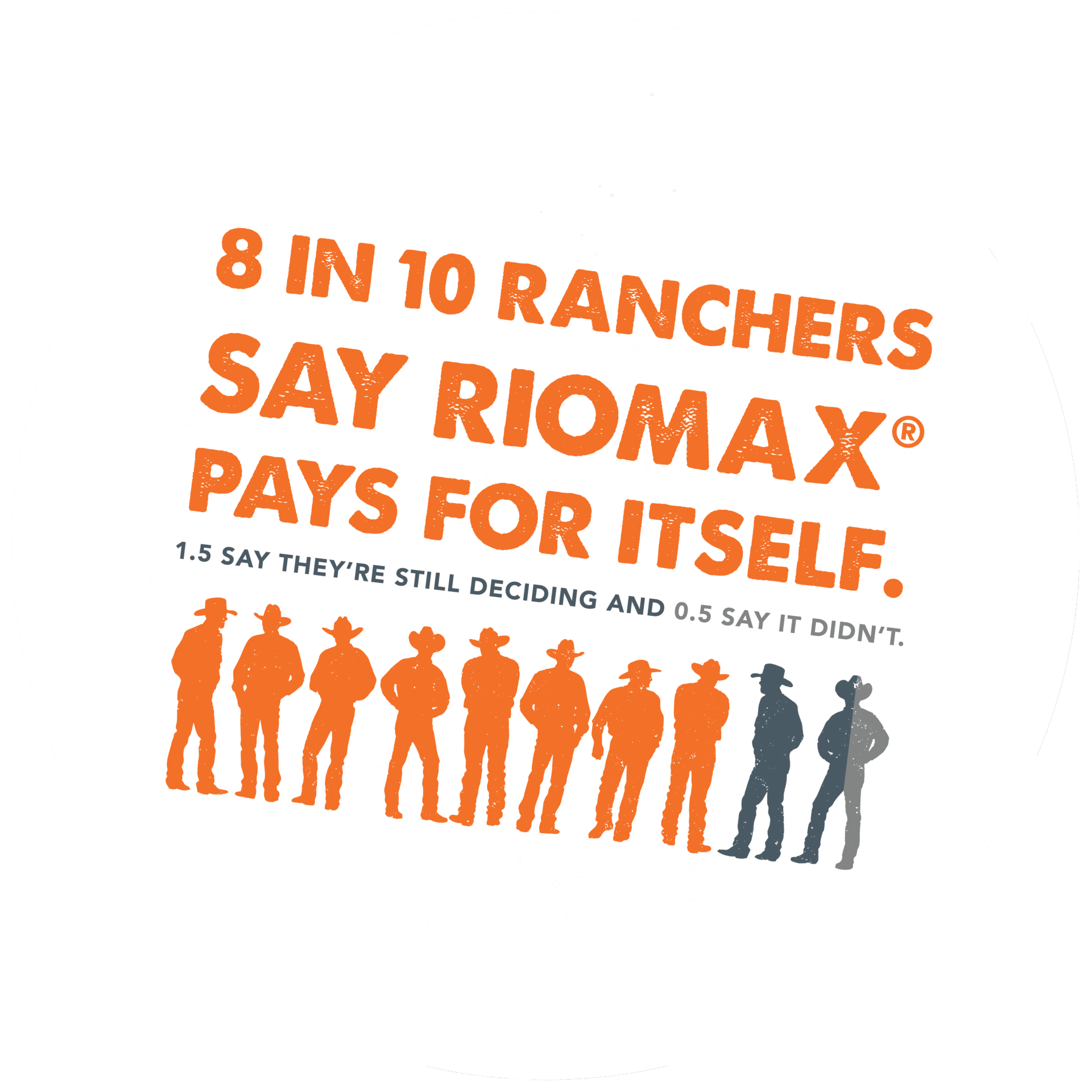
Our herd health guides and network of dealers are here to ensure Riomax® is paying for itself.
Reach out & let’s talk about your ranch
Help us understand the needs of your ranch & the challenges you face. Then we’ll crunch the numbers to see if Riomax is a fit for your ranch.
FIND THE RIGHT NUTRITION PROGRAM
Get a program that fits your needs and pays for itself. Shipped direct or through our dealer network.
ENJOY ONGOING SUPPORT
Our herd health guides and network of dealers are here to ensure Riomax® is paying for itself.
9 Metrics Every Profitable Rancher Should Track!
Progressive, profitable ranchers don't become successful just by a little bit of luck. They treat their ranching operation as a business that's gotta make money. Download this PDF to discover 9 key metrics that many successful ranchers watch to keep them on the right track.